A manuscript titled “A Fair Assessment of Sea Ice Age Reduces Bias and Gives New Insight to Arctic Sea Ice Dynamics”, led by Richard Davy (NERSC, and member of WP500), has recently been published in Geophysical Research Letters (GRL).
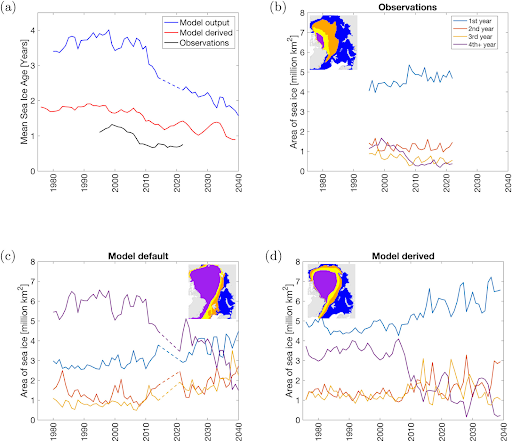
It presents the application of an ice-tracking algorithm to diagnose sea-ice age from daily concentration and drift data in a climate model and compares it to satellite-derived estimates using the same method.
It is shown that the derived sea ice age retains the spatial pattern and long-term trends of the reported model age, but with less than half the bias. Changes in sea-ice age highlight shifts in sea-ice dynamics more clearly than thickness or volume. This shows that using a common algorithm enables both a fair model validation and improves insight into sea-ice dynamics.
Figure 3 from the manuscript is shown below to highlight significant differences between the Model Derived and Model Default data sets and their respective biases relative to observations.